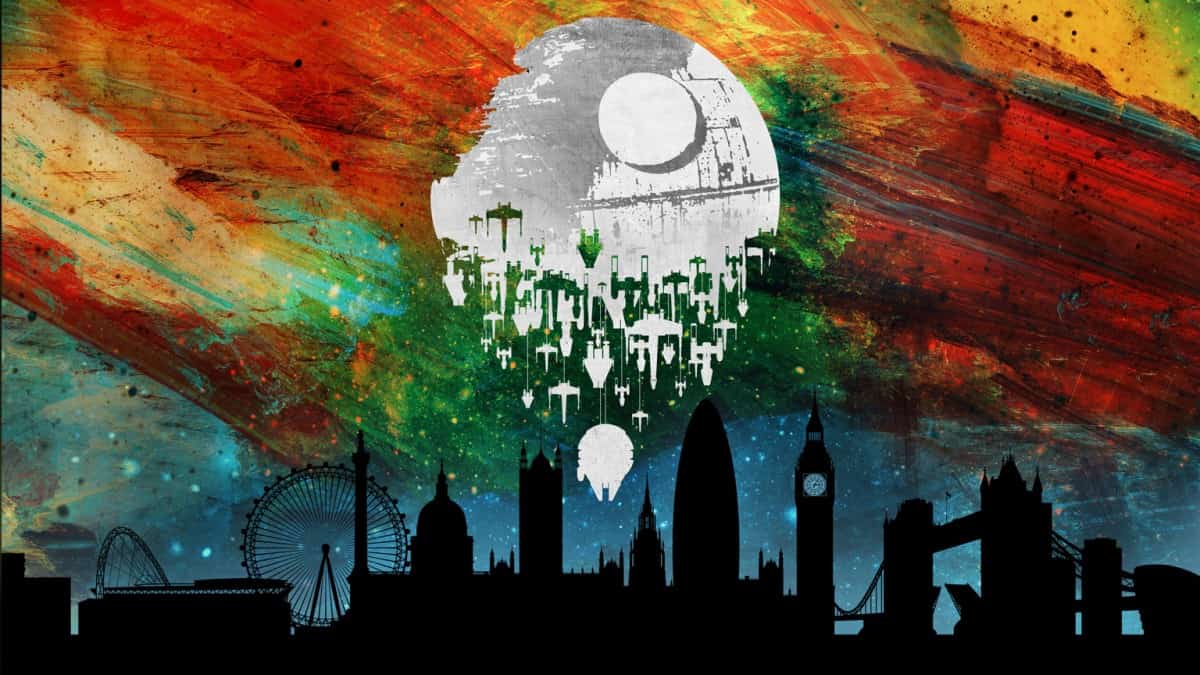
The rebel fleet is ready to make the jump to Europe! StarWars.com Team
Next spring, the Rebellion is landing in London.
Today Lucasfilm and Reedpop unveiled the key art for Star Wars Celebration Europe 2023, featuring a fleet of rebel ships, led by the Millennium Falcon, on course for the London skyline in a nod to Star Wars: Return of the Jedi, which marks its 40th anniversary next year. Amid the colorful backdrop the ominous silhouette of the second Death Star looms.
A limited number of tickets are still available for the four-day fan event, which will be fully operational next April at the ExCeL London. And keep your eyes on StarWars.com as we get closer to the main event and begin announcing exclusive merchandise, panels, and special guests! Official Pix will once again manage all autograph guests at the show. Stay tuned for mail-in and reservation details as well as more exciting announcements about other celebrity guests slated to appear….
This week in Star Wars, we take a look at the new poster art for Star Wars: Tales of the Jedi, make our Star Wars plans for New York Comic Con, and get hit with the Moth Madness in episode four of Andor streaming now on Disney+. Plus, Genevieve O’Reilly stops by to talk about stepping back into the role of Mon Mothma.
Lucasfilm’s recently-completed Disney+ show Obi-Wan Kenobi saw the titular Jedi Master become entangled in a rescue mission that he didn’t want to participate in. However, it’s through this adventure that he rediscovered his connection to the Force and forged a bond with Princess Leia in the years before A New Hope.
Those who watched the series will know that Leia was kidnapped by the Empire midway through and taken to Fortress Inquisitorius. Kenobi, of course, had to come to the princess’ rescue and infiltrate the fortress.
As he roamed the lower depths of the structure, Obi-Wan ended up coming across a ghastly sight: a series of tombs for dead Jedi. Among the deceased Force-wielders were some familiar faces from other Star Wars projects, and it seems like not everyone made it into the scene…
From Ad Art to Episode II – An Interview with Marc Gabbana
January 15, 2001 – When concept illustrator Marc Gabbana signed on for Episode II, he knew that a lot of people would potentially see his artwork. Little did he realize that his tight black and white marker illustrations would be the first piece of Episode II concept art to be seen by the public when it appeared on The Official Star Wars Website’s Episode II section.
“It’s so funny,” says Gabbana. “I followed some of the discussions on the net of people trying to figure out what it was. The big news that day was that Hayden Christensen was cast. People were talking about that. Then someone said, ‘Enough about that… what are those things on the Episode II web page?’ The speculation around anything Star Wars related is phenomenal.”
Even Gabbana had to look closely to identify some of the cryptic images incorporated into the page design. “When I saw the site for the first time, I had to do a double-take. I didn’t recognize it at first, because I had done those drawings months before. It was one of the early concepts, too.”
Though Gabbana remains tight-lipped about what exactly is shown in the website illustration, he did find the numerous theories about it amusing. “One guy wrote online that it’s probably some piece of throw-away art that they’re just giving us to throw us off. Another guy was the funniest. He said, ‘no, I know what it is.’ A friend of his friend’s dad whose son was in Vietnam with another friend now works at ILM or something, and they told him what it is. It’s amusing. These guys talk with absolute authority.”
Gabbana came in on the tail end of Episode I’s production, providing storyboard and production art. “I didn’t have much to do as far as concepts go, because everything was already designed. But on Episode II, I got in from the inception, and my responsibilities are far greater. I got to design many more things, which is good.”
Gabbana, whose background includes a lot of advertising art, finds concept illustration liberating. “It teaches you to be a lot more spontaneous, and if an idea sparks another, you just do another drawing. Production paintings are really the icing on the cake after all the design had been done. Star Wars designs have always been so strong and so distinct, that you don’t need to go through generations and generations of ideas before you hit it the final one.”
“Marc is a great talent, because he excels in the same way that Jay Shuster and Ed Natividad do,” says Design Director Doug Chiang. “He’s naturally a really wonderful artist, and he can draw all manner of shapes and environments. The underlying strength of the Art Department is that they all have a natural ability to draw, and an instinct for their subject matter, be it creatures or mechanical shapes or environments. It’s something you can’t really teach in some ways. You have to see it in your portfolio.”
Gabbana describes a strong level of trust between himself and Chiang, as well as the rest of the Art Department. This is quite important since, unlike most of the department, Gabbana does not work out of Skywalker Ranch. Instead, he works in a studio out of his house in his native Canada and telecommutes to the Lucasfilm headquarters.
“I’m in Windsor, Ontario, right across the river from Detroit,” says Gabbana. “It wouldn’t make sense for me to move out there. I’ve got my girlfriend here. I’ve got my life here.”
With courier services and e-mail, Gabbana kept in constant touch with Chiang and his fellow illustrators at the Ranch. “It’s very collaborative. I would send some drawings to Doug and then he would make certain revisions verbally. I would just send him a new batch, and go off on a tangent that I perhaps would not have thought of,” he says.
“I think Doug appreciates it too because I’m not influenced by what the other artists are doing in house,” adds Gabbana. “That’s kind of a mixed blessing too, because sometimes I want to see what’s going on. Doug e-mails me the relevant images for given scenes, but I’m not able to see what Jay or Ed are doing day-to-day. But that’s okay; I think this way I’m able to send fresh ideas, and not have it influenced by anybody in house.”
Before his illustration career took off, Gabbana studied architecture, a field his father wanted him to follow. “After a year I decided it wasn’t quite for me, so I transferred,” he says. He notes, with irony, that the training still applies. “I’m now a Star Wars architect. I’m very happy with that.”
Gabbana next studied illustration at the Center for Creative Studies in Detroit. “That’s where everybody went,” he says with a smile — both Natividad and Chiang studied there as well. After graduation in 1990, he stayed in Windsor to launch a career in advertising. “I did freelance work for a bunch of companies in the States and always kept up my own portfolio. The movie industry was something I’ve always wanted to do.”
In 1995, Gabbana met Doug Chiang at ILM, and showed him his portfolio. “Later, I heard of an opening on Episode I, so I just called him up and got hired direct on the spot,” says the artist.
“Everyone who works in the Art Department has it: a spark that went off when they were kids, ” says Gabbana. “That’s what happened to me when I was 11, in 1977, when Star Wars came out. What impressed me the most was Ralph McQuarrie’s work. The fact that you could make these fancy fantasy paintings, and someone pays you for it. I thought, Wow… this could be a job?”
A fateful freelance assignment brought Gabbana in touch with his inspiration. “Ralph McQuarrie was doing some freelance work for Galoob Toys, and so was I at the time. The Galoob art director got me in contact with him and introduced me to him. We struck up a friendship. It was great.”
Of his work and designs, Gabbana is eagerly awaiting the return of Coruscant on the big screen in 2002. “I did a lot of those big scenes. Hopefully I’ll be able to design some of the matte paintings. Even though I won’t personally be doing the finished matte painting myself, at least I’d like to get a chance to do some really tight color comps.”
Episode II Art and Architecture:
An Interview with Kurt Kaufman
November 16, 2000 — When not helping envision the new concepts of Episode II, Concept Artist Kurt Kaufman tries to find time to illustrate for himself, for relaxation. “I’m usually just too burned out to do that. But when I’m not working here, I do traditional and computer illustration, professionally and recreationally, to keep my skills up. Landscapes, vehicles, architecture.”
His subject matter is not surprising, since this is also what Kaufman worked on in Episode II. “If there’s a focus to the work I do, then I’d say it’s mostly architecture,” he says, “and a lot of background and scenic shots. Very little of what I do is establishing the initial look. Mostly I extrapolate on looks that have already been established by some of the other designers. But I’m doing a lot more concept design on this film than I did on Episode I.”
Kaufman studied transportation design while at Art Center College of Design in Pasadena. The move to Los Angeles exposed him to the world of film. “My dad was a car designer at Ford,” explains Kaufman, “and I thought I would probably do car design or product design of some kind. But when I was in school I got disillusioned with real world design, and became intrigued with the film industry. Of course Star Wars was very inspiring, but when I saw it, it never really occurred to me that I could actually work on something like that. That was such a world apart from where I was. But when I was in school Alien and Blade Runner came out. Those movies really inspired me, and I started thinking seriously about working in the film and entertainment industries.”
After graduating from Art Center, Kaufman worked in LA as a freelance designer and illustrator for about five years. He eventually landed a job in northern California, working at Industrial Light & Magic, where he met Doug Chiang in the ILM Art Department, along with a crew of other very talented artists including Iain McCaig. Later, when Chiang was organizing the Art Department for Episode I, Kaufman was brought on board.
“Kurt is one of those great team members who can bring a lot in from his experience,” says Chiang. “He’s an industrial designer, so he complements the team really well because he can fully flesh out environments and vehicles. He approaches it from a very practical design point of view, and brings to it aspects of reality. The designs look like they can work. It’s one thing to have people who can draw things really well, but it’s another to have people who can really figure it out and make it look like they can function.”
For Episode I, Kaufman joined the team later in the game, and much of the concept phase was already completed. His contributions, however, were important for the Animatics Department. “Mostly what I did on Episode I was filling in blank areas behind the live plates that had been shot. There was a lot of architecture as well, predominantly Theed, Coruscant and Tatooine.”
When The Phantom Menace moved into post-production, Kaufman moved to the ILM matte department to work on finished shots. “A sequence I worked on that comes to mind is the sequence where Obi-Wan, Qui-Gon and Jar Jar are in a Gungan submarine. It comes up out of the water and it’s the first time you see Theed,” says Kaufman. “Matte painting is all done digitally now; it’s a combination of digital painting and assembling other elements. These shots had some beautiful miniature models in them. It’s a major team effort at that point.”
For Episode II, Kaufman was brought aboard much earlier, and worked on both concept designs and storyboards for the major action sequences. “I prefer doing concept design.” says Kaufman, “For me, it’s a lot harder and more demanding, but it’s also more rewarding. I like being involved in the whole process, though. Hopefully after the Art Department is done, I’ll get to go down to ILM and work in the matte department again. Following through on the final art is really rewarding as well.”
Kaufman’s transportation design background served him well for Episode II, in the design of a Naboo bus that will be seen in the film. ” I try to work in my car influences, but it’s difficult because it’s not the real world, plus I’m trying to predict what George Lucas is going to like and what Doug is going to like. But definitely my automotive design education has helped me get to this point.”
Another scene Kaufman’s particularly looking forward to takes place in a shadowy abandoned district on Coruscant. “I did a concept for that scene, so it’s mainly mine with some of Marc Gabbana’s influence.”
Collaboration is key in the Art Department, and Kaufman has worked closely with Jay Shuster, Ed Natividad, Marc Gabbana and Doug Chiang. “Doug is the one I get most input and direction from, and some of the work is shared. A lot of what the other artists do influences a lot of what I do. And, of course, in many ways it’s all derived from George’s original vision.”
Kaufman’s own style has grown in his time with the Art Department, which he credits to the caliber of artists he worked with on a daily basis. “It’s much more disciplined here. There’s less focus on technique, and more focus on design and composition. ” he says. “Some of my work in the past was comparitively loose and sketchy. My work has come a long way because I’m working with people who are really motivating, inspiring and some of the best in the business. Working here at the Ranch on Star Wars with this crew has definitely been a high point in my career.”
Here you’ll find a collection of old features pertaining to various articles to do with the movies, in front & Behind-the-Scenes at SW.Com
Today, we have a small collection of thumbs from the Art of Revenge series in which the teasing got worse for, what we thought at the time was the final Star Wars movie. Check out the small gallery.
The Art of Visual Storytelling Ryan Church and Erik Tiemens
Previsualizing Lighting, Mood and Color
A common notion is that when a film is as deep in its post-production phase as Episode II is, the concept art work has long been completed and the Art Department sits empty. That is not the case for Erik Tiemens and Ryan Church, two talented artists that were brought in late last year to offer their talents in developing Episode II’s rich palette of color and mood.
“We provide key-frame production illustrations that are the link between the concept work that Doug [Chiang] and his group did, and the final work that the ILM matte painters and the effects crew will be doing. It’s kind of previsualizing lighting, mood and color schemes,” describes Church.
“Studying footage that has been shot in Australia, London and elsewhere, we are sometimes dealing with lightly constructed sets and lots of blue-screen captured on digital plates,” says Tiemens, “Our job is to take that blue-screen void and make it come to life as environmental landscapes via production paintings. This provides a method of blocking out scenes, quickly giving George Lucas a flexible template in the editing room. In collaboration with the animatics artists’ 3-D work, we can deliver a complete rough cut to ILM as a reference guide.”
“Some of the colors we’ve been working with are very bright reds and oranges,” describes Church, “very passionate and luminous, hearkening back to historical illustration. There are foreboding color schemes and atmospheres that go with the story as well. It’s all very dramatic.”
The heightened dramatic potential drew Tiemens to the project. “I was delighted to hear that [Producer] Rick McCallum and George wanted to intertwine a feeling of drama and moodiness as often seen in turn of the century American landscape painting, like that of Thomas Moran and Albert Bierdstadt. When I see a stormy sky over the bay, with one little glowing pocket of sunlight glittering near the horizon, I am struck by the emotions it carries –- something mysterious and hopeful. Observing different lighting conditions, colors and how you frame the subject matter are all crucial to the visual storytelling process.”
In addition to quick yet detailed color studies, the two have delved into concept designs tied to specific shots and camera angles, as well as conceptual work on new elements that have popped into the evolving storyline. “There are a couple of major sequences that weren’t completely fleshed out. Erik and I have had a chance to get into it, and design it from the ground up,” says Church.
The two artists bridge the Art and Animatics Departments, working to produce illustrations keyed to specific animatics camera angles. “It’s designed for a shot,” explains Church of some of his work. “It examines an environment that was roughly designed by Doug’s group. What does that environment look like with this specific plate? What does it look like in this shot?”
Once the artwork has been completed and approved, usually on a very tight schedule, the digital art is carefully composited into the animatic to fill in the empty blue and green-screen currently throughout Episode II. “The animatics demands are so heavy that often we’ll get something in the morning that will be due at the end of the day,” says Church. “Erik and I did 14 paintings in two weeks of the end battle, and they got all approved by George. That means we were really on the same page, conceptually, because we kind of went crazy. We were kind of pushing things.”
“We have a quick turnaround rate,” concurs Tiemens. “I think that’s good, because as artists we can be overly precious with details in artwork. It’s refreshing to me. You are literally working at a gut level response. If George wants a rich, moody sunset in a decrepit warehouse district, you may not have the time to explore the idea with various color thumbnail sketches, but rather you just get it done on that one final.”
For scenes that will be entirely computer-generated, like some of the epic vistas seen in the last quarter of the film, Church and Tiemens have produced rich, colorful production paintings envisioning these important events. These paintings serve as valuable reference for the finished shots that will be delivered by Industrial Light & Magic.
“It’s like doing a digital feature,” says Church. “Doing these all digital environments where you have to design everything about it. You’re building, and designing and lighting everything. This is more similar to that than a typical live action show.”
The two artists, though traditionally trained in hands-on brush and paint, use digital tools to mimic the look. “It’s for the time-constraint,” explains Church. “We’re working over digital files that are sent to us by the Animatics Department. It’s always quicker to work on the computer. You’ve got the flexibility that you don’t have with a traditional painting. It stays within the digital realm instead of having to go back out and be scanned and taken back in and adjusted. It just saves a lot of steps.”
“The software we use bridges the gap between digital art and my preference for sketch painting outdoors using gouache and pastels,” explains Tiemens. “You can bring some of that spontaneity into the digital medium with these programs. A quick pencil layout can be scanned in the computer, providing a base for a digital painting. We also send digital files to Animatics and see how lighting on the actors holds up with our backgrounds, to see if we are getting a match.”
“I was the last person to ever want to touch a computer as far as art is concerned,” recalls Church. “I studied transportation design, and it was all markers and pens and tracing paper and hands-on. But you really can’t argue with the power of a computer for commercial artwork like we’re doing, where there’s going to be a lot of revisions anyway, and the deadlines are so tight.”
Artistic Backgrounds
Church grew up surrounded by artistic influences, as his father is an industrial designer. Citing such inspirations as Syd Mead and the original art of Star Wars, Church began down the path of commercial art with the intent of being a car designer. “I was pretty focused in car design all the way until about fifth term of school when I started doing real car design, as opposed to fun, splashy concept car design. I realized that the entertainment art industry offered a lot more fun stuff to work on, instead of designing a functional product like door handles all day.”
Following the freedom that movie concept work promised, Church eventually found himself working in the Digital Features department of Industrial Light & Magic. From there, he was contacted by Iain McCaig of Episode II’s Art Department. “Iain said that they were looking for painters, illustrators and designers, and he used the term ‘Ralph McQuarrie-types.’ He said I should submit my stuff. So I did, and got a call a while after that, to come up and join the team. This is obviously the realization of a lifelong dream, since looking at the Joe Johnston sketchbooks,” recalls Church. “That’s the stuff I copied when I was a kid.”
Also inspired by Star Wars and classic movies in his youth, Tiemens studied traditional drawing and painting at Art Center College of Design in Pasadena, California, graduating with Distinction in 1990. “I developed a deeper appreciation for the arts there, especially 19th century painting. The learning there has brought references into my film work. In the digital medium where we need to invent new things, like environments, it’s always nice to create a link to the visual past. I believe if we’re only looking at what’s been done in the past few years or so, it gets tiring to the audience. To look back on the layers of history, early photography, sculpture, painting and the arts in general gives us a more rewarding experience.”
Specific to Tiemens are influential painters like John Singer Sargent and muralist Frank Brangwyn. “They are a rich source of inspiration for me not only in their amazing skill but sense of spirit in their works, something always alive there. I can only hope to aim in that direction.”
Tiemens, too, was recommended by Iain McCaig from work the two did on an ILM project. Tiemens’ previous experiences included such films as Forrest Gump, Jurassic Park, Contact, Star Wars: Special Edition and the Emmy award-nominated effects in the opening title sequence from Star Trek: Voyager.
“Last fall I was in Europe for a couple of months on a painting trip, seeking out inspiring locations,” recalls Tiemens. “I think it’s always good for artists to go out and recharge your batteries, creatively speaking. Traveling about in southern Italy at the time I found a café to check my email. I was astonished to get an email from David Dozoretz. He asked if I was interested in working on Episode II; they were looking for someone to produce dramatic environmental landscape paintings for the film.” Rick McCallum and George Lucas took a look at Tiemens’ portfolio on his personal website, and from that invited him to join the Episode II production.
Visiting five planets, the film has a lot of territory to cover in its allotted running time, and Star Wars films are not known to dawdle about in any one given location. “We’re visiting a lot of places from Episode I, but we get to see a lot more of them,” reveals Church. “We’re literally going below the surface of these locations. And there are these new worlds, just like the other Star Wars movies, with color schemes that seem to be very deliberately picked by George to reflect and mirror the story. It’s very subjective visual storytelling that supports the script.”
Artistically, Church and Tiemens are in a unique position of being able to touch the whole story — from beginning to end — with their art. “We’re covering a lot of ground,” says Tiemens. “Typically, a matte painter would spend maybe two weeks — at the shortest — or about a month or two on a complex shot. They may have a few very important shots in the film at a high degree of detail, but we’ve had the rare opportunity to go over the entire film. We view it from a global perspective in a rather short amount of time, touching on most of the environments through production illustrations. Abstract color and lighting themes are closely kept in mind.”
Concludes Tiemens, “Working on this project is similar to designing a digital feature; you try to look at the overall, in each reel, and ask yourself, ‘does this time of day support the story? How does the character feel right now? Can a busy sky with clouds compete with the actor’s somber lines?’ A million puzzles like these come up all the time. That makes for a challenge experience, full of surprises.”